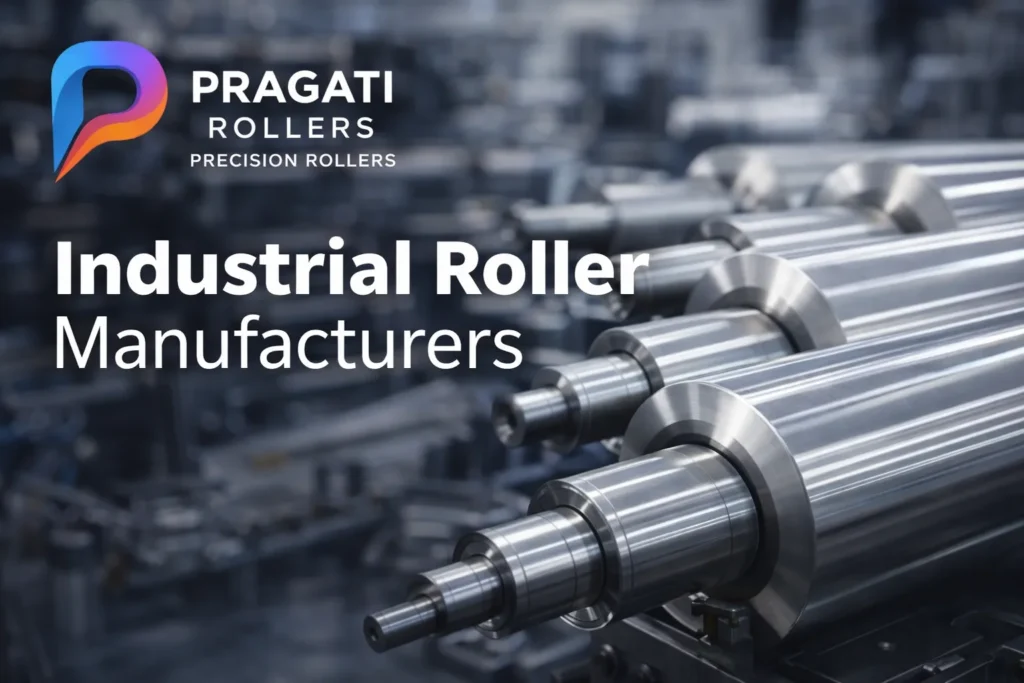
In any manufacturing facility, steel, printing, packaging, or tube mill, you will see industrial rollers that work behind the scenes to do the heavy lifting everywhere. They don’t get the attention, but if these rollers break down, the manufacturing process doesn’t just slow down; it comes to a complete halt.
At Pragati Rollers, industrial rollers are not mass-produced items. Each roller is designed based on load, speed, material interaction, and operating conditions, because in real-world manufacturing facilities, no two processes are alike.
Let’s discuss what industrial rollers are and, more importantly, the different types, materials, and applications for which Pragati Rollers designs them.
What Are Industrial Rollers?
Industrial rollers are cylindrical components that rotate to move, guide, press, coat, or support materials in a manufacturing process. Depending on the application, they may be required to:
- Support heavy loads continuously
- Provide surface grip without damaging the material
- Withstand heat, abrasion, chemicals, or deformation
- Operate at high speeds with minimal vibration
That’s why industrial roller design is not generic; it’s application-specific.
Types of Industrial Rollers
Different types of rollers for industrial roles are available. Here are a few of them.
Rubber Industrial Rollers
Rubber industrial rollers are designed for applications where grip, cushioning, and controlled pressure are essential. Their key features include high friction to ensure positive material movement. They can absorb vibration and shock loads and can be customised for hardness and surface finish.
Common Applications: These rollers are used in the following:
- Printing and lamination machines
- Packaging and sheet-feeding machines
- Textile processing machines
Polyurethane (PU) Rollers
Polyurethane industrial rollers are used when rubber is not hardy enough, particularly in high-wear applications. Key features includeexcellent abrasion resistance, higher load-carrying capacity than rubber, and longer life under continuous operation.
Typical Applications include the following:
- High-Speed Converting Machines
- Industrial Handling Systems
- Packaging and Coating Lines
Steel & Metallic Rollers
These are heavy-duty rollers designed for harsh industrial conditions. Their key features include high strength for continuous load and torque, and precision-machining for balance and alignment.
Typical Applications: They are suitable for rolling Mills, Tube Mills and Steel Processing and Forming Lines
Squeeze Rollers
Squeeze rollers are designed for pressure-driven applications where liquid or coating needs to be controlled. Their features include uniform Pressure Distribution (a surface designed to prevent material damage) and consistent performance under compression.
Common Applications: Typical Applications include Printing and Coating Machines and Lamination Units.
Stabilizer Rollers
Stabiliser rollers provide alignment and material stability during processing. They are known for suppressing material vibration, ensuring consistent tracking, and improving overall machine accuracy.
Common Applications: These rollers are used in material handling systems, high-speed production lines, web guiding and alignment processes and materials used in pragati’s industrial rollers. Each roller is designed by matching material properties to operational stress.
Material Selection
Material selection has a direct effect on the life of the roller, maintenance cycles, and machine efficiency, which is why it is never a one-size-fits-all approach.
- Rubber Compounds. Rubber compounds are perfect for grip, flexibility and cushioning.
- Polyurethane: They are perfect for abrasion resistance and longer life
- Mild Steel/Alloy Steel: Pick them if you want strength, rigidity, and high-load applications
Final Thought
Industrial rollers are uncomplicated, but their performance determines the efficiency of the machine, the quality of the product, and the reliability of the machine. By designing rubber, polyurethane, steel, squeeze, and stabiliser rollers based on actual plant conditions, we at Pragati Rollers ensure that each roller performs in sync with the machine, not against it.