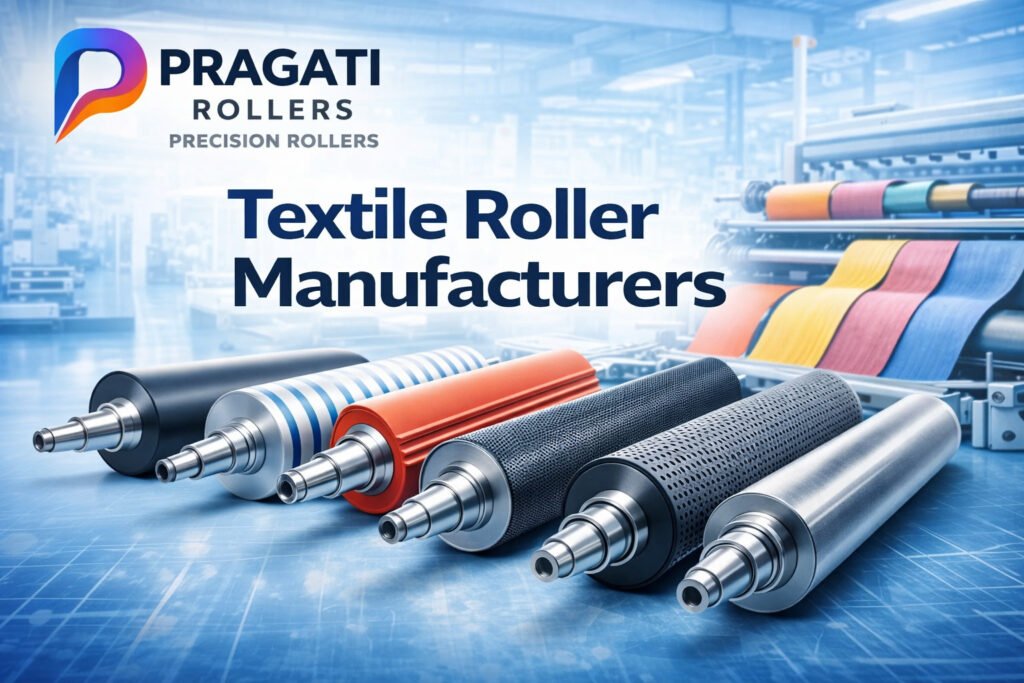
The quality of any fabric depends hugely on how it is processed through rollers, because textile rollers perform multiple functions, including transporting, guiding, pressing, and applying tension to a piece of fabric. Precision in each process determines how good the cloth turns out. From garments to bed sheets, from surgical gowns to seat covers in automobiles, numerous segments of the textile industry depend on the performance of the rolling setup.
Pragati Rollers is a trusted name among the top textile roller manufacturers. As an experienced expert, we address the specific needs of dyeing, printing, and finishing for a specific surface, hardness, and resistance profile. Therefore, we have a wide range of rollers designed and manufactured to address these diverse demands.
Let’s look at the different rollers used in different processes in the textile industry.
Dyeing Processes
Dyeing rollers are exposed to water, various chemicals and changing temperatures, so textile roller manufacturers build them to resist swelling and corrosion.
Squeeze Rollers
These are essentially used to remove the excess dye liquor after the fabric immersion process. They ensure proper consistency of shade and uniform dye absorption.
Rubber Rollers
Polyurethane, neoprene and hypalon rubber rolls are common for dyeing. Polyurethane has a strong grip and traction is needed for controlled pressure, hypalon for resistance against aggressive dyeing agents and neoprene rolls for modern chemical resistance.
Printing Processes
Textile roller manufacturers consider accurate positioning and precision patterns to be the key requirements of the printing process.
Deflector Rollers
Without disturbing the alignment or tension, the deflector rollers guide the fabric through the printing line and manage the changes in direction.
Rubber-Coated Rollers
These ensure that the fabric isn’t slipping during printing to maintain sharp and consistent patterns.
Finishing Processes
In this process, the surface quality and texture are improved. Fabric appearance is enhanced for marketability.
Rubber Polyurethane Rollers
Pressure and guiding applications used these rollers due to their flexibility and durability.
Hard Chrome Rollers
These rollers are widely used in coating due to their superior surface smoothness and wear-resistance. They help fabric achieve uniform finishing and enhanced fabric texture.
Roller That Is Common Across All Processes
A Stabilizer Roller is common in all textile rolling operations because it is used to maintain alignment and tension throughout the various processes. It prevents the development of wrinkles, distortions, and uneven treatment and maintains uniform contact with the fabric.
How to Choose The Right Roller
As there are various types provided by the textile roller manufacturers, knowing which one is required in your process is crucial for your textile production line. Here are the key factors you must consider:
Nature of the Process: Dyeing, printing and finishing, all the processes have unique and some common rolling equipment requirements.
Chemical Exposure: Strong or mild chemical exposure will determine whether you need a particular type of roller made of rubber or steel material.
Surface Roughness requirements: A high polish surface is required for minimal traction, while a textured surface is required for grip.
Operating Conditions: Assess the combined effect of speed, temperature, and pressure and choose the type suited for your operating conditions.
Load Handling: Ensure that the rollers have suitable load handling capacity for uniform pressure and avoid deflections under load.
Conclusion
A well-matched roller performs consistently and delivers the outcome as desired with negligible errors. In modern, automated textile lines, the rollers work as a part of one big unit, and their function is to guide, transport and create optimal tension on the fabric. The textile roller manufacturers like Pragati Rollers provide numerous variants which are applicable across the printing, dyeing and finishing operations. By considering the above tips and classifications, one can choose the right combination of roller for their production line.