Rubber rollers are an essential part of many industrial operations in the textile, printing and packaging industries. Pressing machines and conveyor mechanisms widely use this roller due to its ability to provide controlled movement, uniform pressure and surface grip. There are several variants developed by the rubber roller manufacturers based on hardness levels and functional requirements. Hypalon and Neoprene are the two widely used rollers made of rubber. Both of them offer distinct performance in any application they are used in.
What is Hypalon Rubber Roller
A hypalon rubber roller is a manufacturing machine element made of chlorosulfonated polyethylene. This compound is known for its resistance to chemicals and temperature variations. Its flame spread resistance is strong due to the presence of chlorine content.
Features of Hypalon Roller
- Resists damage by acids, alkalis, oils, and many industrial chemicals.
- It doesn’t degrade quickly like natural rubber.
- It can handle a high temperature range.
- Suitable for wet and humid conditions.
What is Neoprene Roller
Neoprene is developed from chloroprene polymer, a great material for industrial rolling operations. Its surface provides good grip and traction for material handling operations.
Features
- Remains dimensionally stable even under compressive force.
- One needs to put relatively low maintenance efforts.
- Combines cushioning with durability.
- Has a strong abrasion resistance.
Key Differences
Before selecting the rubber roller manufacturers, it is important for the buyers to know the distinctions between the two very famous types of rubber rollers. Here are the key factors based on which we will differentiate between the mentioned roller types:
Chemical Resistance
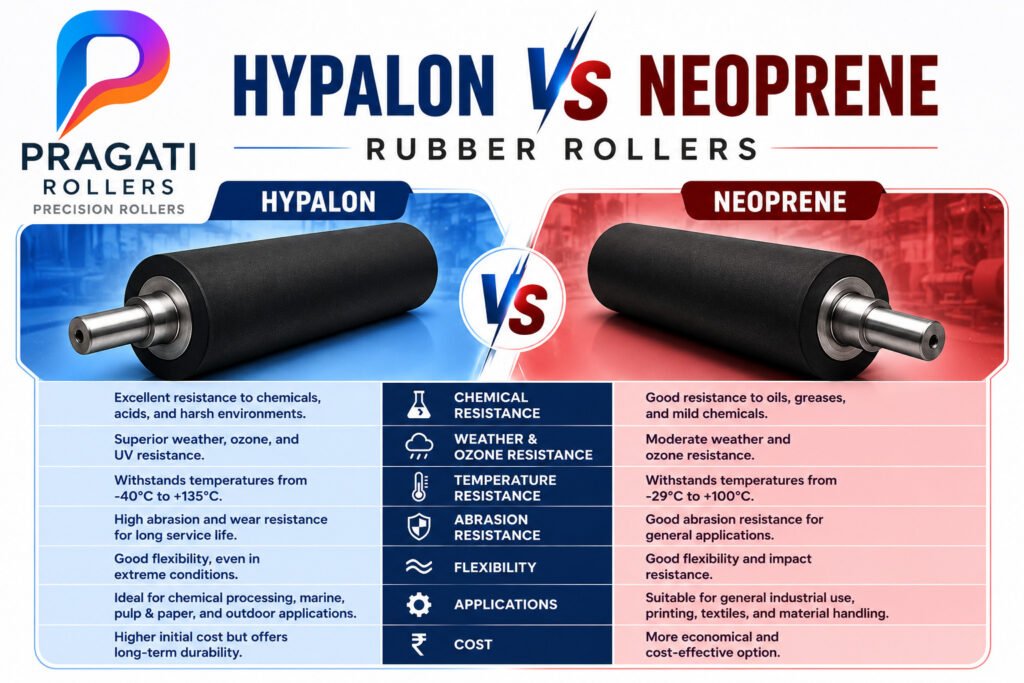
Hypalon has superior chemical resistance to neoprene. More than 70 % of industrial chemicals can be handled by it, while neoprene performs well against mild chemicals and oils only.
Strength and Abrasion Resistance
Hypalon roller has high tensile strength and abrasion resistance, which is larger than neoprene. It can withstand hours of harsh operations. Neoprene has moderate abrasion resistance and tensile strength between 10 and 17 MPa.
Oil Resistance
Neoprene excels in this factor. It has superior oil resistance to hypalon rubbers. Petroleum, grease and other oils cannot practically degrade neoprene, while Hypalon is only resistant to a certain degree.
Temperature Handling
Heat ageing performance of the Hypalon roller is incredible. It can withstand a temperature range up to 120 degree Celcius. While Neoprene degrades faster above 100 degrees.
Cost Difference
Hypalon is 20 to 40 % above Neoprene when it comes to cost. Neoprene is more economical for general manufacturing uses.
Applications
Hypalon roller is widely used in industries where machinery faces harsh chemicals, outdoor exposure, moisture, and high temperatures. Neoprene is applicable in industries requiring flexibility, oil resistance, and stable mechanical performance under moderate operating conditions.
Conclusion
Now that you have understood the key differences and suitable applications, you can make the best judgement in choosing a reliable one from the leading rubber roller manufacturers. Hypalon has superior material qualities, while neoprene is more useful for the lighter rolling works. We recommend you choose Pragati Rollers, a top supplier of rollers for industrial uses. Our team provides suitable rollers for the industrial applications of the clients.