Rubber rollers are widely used industrial components. In the manufacturing and processing facility, rolling has many applications. From guiding the sheets to tensioning, from conveying to material handling, rollers need a firm grip. Over the years, rubber roller manufacturers have come up with a variety of types. Let’s look at these varieties and their applications.
Rubber Roller Construction
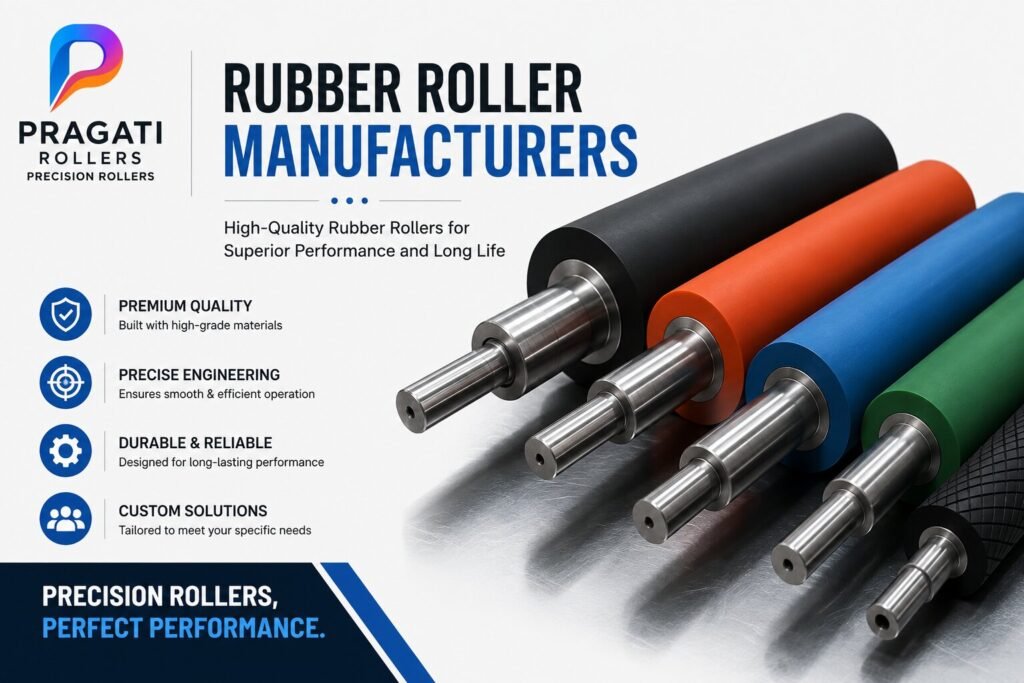
Before proceeding to different types of rubber rollers, it would be helpful to understand how a rubber roller works. An industrial rubber roller typically consists of a precision-machined metal core that is covered with elastomer for a specific application. Factors such as hardness, bonding, and surface texture influence the performance of the roller. These determine the longevity of the rubber roller:
- Rubber compound
- Shore hardness
- Surface finish
- Chemical resistance
- Temperature tolerance
- Load-bearing capacity
- Rotational speed
Rubber Rollers Variety and Applications
Natural Rubber Rollers
Natural rubber delivers the best elasticity and resilience together with the grip. This means that these types of rollers are selected in case flexibility and shock absorption are required. It is suitable for:
- Paper handling
- Textile processing
- Material conveying
- Light industrial equipment
Hypalon Rubber Rollers
When extreme chemicals and harsh weather conditions are involved, Hypalon is considered to be the best material for manufacturing rollers. Due to its great resistance to oxidation and chemicals, these rollers work properly even in difficult conditions. The preferred applications are:
- Chemical processing and acid/alkali handling lines
- Water and wastewater treatment plants with chlorine and ozone exposure
- Steel pickling and surface treatment lines
- Marine and offshore equipment
Neoprene Rubber Rollers
Neoprene is characterized by its good level of resistance to heat, weather, oil, and chemicals. Neoprene is a very useful material for industrial rollers. Typically, it is used in:
- Printing
- Packaging
- Chemical processing
- Paper manufacturing
Nitrile Rubber Rollers
When it comes to the production of lubricants, oils, and petroleum-related products, nitrile rubber is the optimal choice due to the higher oil resistance, which prolongs the lifespan of the product compared with traditional rubber compounds. It is common for:
- Steel processing
- Automotive manufacturing
- Metal fabrication
- Industrial machinery
EPDM Rubber Rollers
EPDM is formulated for resistance to moisture, ozone, UV light, and steam, making it an unsuitable choice for outdoor and high-humidity places. Its weatherability makes EPDM suitable for applications where other materials degrade quickly. These are favourably used in:
- Water treatment plants
- Textile finishing
- Food processing equipment
- Outdoor industrial machinery
Silicone Rubber Rollers
Silicone rollers maintain their properties even at extreme temperatures. They also have highly effective release capabilities, which make them very useful in coating and laminating. Industries use them in:
- Food processing
- Pharmaceutical manufacturing
- Electronics
- Medical equipment
How Industries Use Different Rubber Rollers
Steel Industry: Sink rolls, stabilizer rolls, deflector rolls, and polyurethane-coated rolls are the types of rollers that are used in processing and galvanizing lines.
Printing Industry: The rubber rollers in printing presses are sufficient to function well in ink transfer, dampening, and paper handling. Surface imperfections can result in distortion of the printed product.
Paper Industry: Different types of rubber rollers are used in the paper making process in different applications such as coating, pressing, guiding, and winding of paper without causing any damage to the surface.
Textile Industry: The rubber roller technology is also applied to textile manufacture including dyeing, squeezing, finishing, and movement of fabric with sufficient pressure application across less resistant materials.
Packaging Industry: Packaging equipment relies on rubber rollers for feeding, laminating, sealing, and conveying products at high production speeds.
Conclusion
Rubber rollers are engineered components essential to the manufacturing process as they directly affect the efficiency of manufacturing, the quality of products, and the efficiency of equipment. Different types of rubber roller products from various materials, like natural rubber, neoprene, nitrile, and special industrial rollers, have been designed to meet more than one operational need. Businesses collaborate with experienced rubber roller manufacturers like Pragati Rollers that can offer customized solutions according to their production needs and help ensure quality standards and consistent manufacturing.